Quick answer
To get rid of foggy headlights, you have to remove the yellowed, oxidized outer layer of the plastic lens, polish it clear, and then protect it from UV so it doesn't come right back. That means wet-sanding the lens from coarse to fine grit, polishing it, and sealing it. Quick fixes like toothpaste only take off a little haze for a few weeks. If the fog is inside the headlight, sanding the outside won't help, and the housing needs to be resealed or replaced.
Rather have it done for you? Get a price in about 15 minutes or text us a photo.
Foggy headlights creep up on you. They get a little worse every year, you get used to it, and one night you realize the road ahead looks a lot darker than it should. The good news is that almost all foggy headlights can be cleared up, and you don't need to buy new ones to do it.
I'm Tilden, owner of Motion Mobile Detailing. Our detailers restore headlights in driveways all over Charlotte, so this is the same process we use, written so you can do it yourself if you want to.
What Makes Headlights Foggy and Yellow?
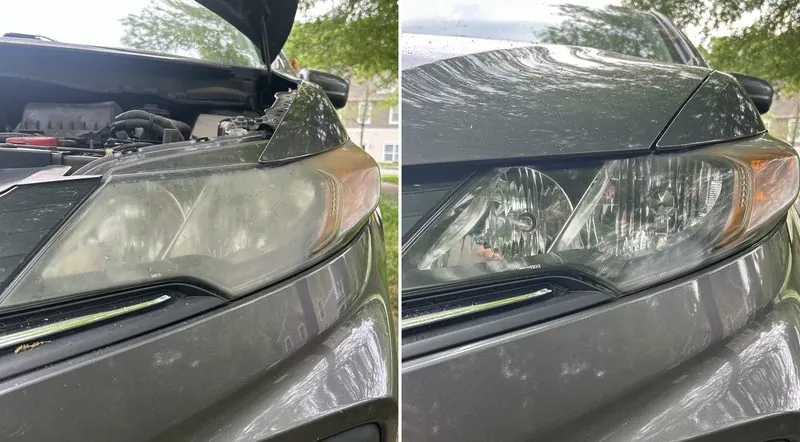
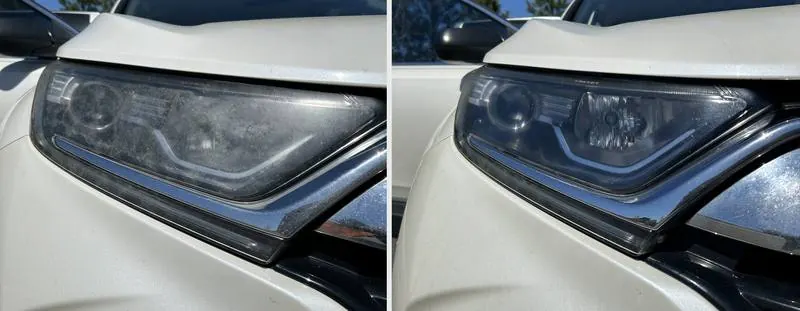
Almost every modern headlight lens is plastic (polycarbonate), not glass. From the factory, it has a clear protective layer on the outside. Years of sun break that layer down, and once it fails, the plastic itself starts to oxidize. That's the yellow, cloudy, sometimes crusty look.
According to AAA, headlights can start showing this as early as three to five years in. Cars that park outside all day in the Carolina sun get there faster. Road grit, harsh chemicals, and brush car washes speed it up too.
First, Check if the Fog Is Inside or Outside
This takes 30 seconds and saves you a wasted afternoon. Wash the headlight, dry it, and run your fingers over it.
- Rough, chalky, or yellow on the surface: the problem is on the outside. You can fix it with the steps below.
- Smooth outside, but you see droplets, haze, or water inside: the seal has failed and moisture is getting in. Sanding the outside won't fix it. The housing needs to be dried and resealed, or replaced.
- Cracked or chipped through: replace it.
How to Get Rid of Foggy Headlights, Step by Step
You can buy a headlight restoration kit at any auto parts store, or put together the same supplies yourself: painter's tape, wet/dry sandpaper in a few grits, a spray bottle of water, plastic polish, microfiber towels, and a UV-blocking clear coat or ceramic sealant made for headlights. Plan on one to two hours for a pair the first time.
- Wash the headlights. Soap and water, then dry them completely. Any grit left on the lens will scratch it once you start sanding.
- Tape off the paint and trim. Use two layers of painter's tape all the way around the lens. Sandpaper and polish will scuff paint fast, and this is the step people regret skipping.
- Wet-sand with the coarse grit. For heavy yellowing, most kits start around 800 to 1000 grit. For light haze, you can start finer, around 1500. Keep the lens and paper soaking wet and sand in straight, even strokes until the whole lens looks evenly frosted. Uneven spots now mean uneven spots at the end.
- Step up through the finer grits. Rinse, then move to about 2000 and then 3000 grit, sanding in the opposite direction each time so you can see when the last grit's scratches are gone. The lens will still look cloudy. That's normal.
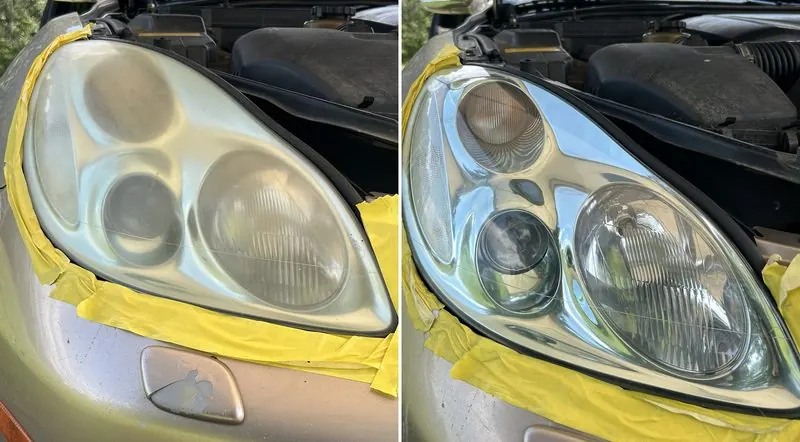
- Polish it clear. Work a plastic polish in by hand or with a drill pad until the lens turns clear. This is where it goes from frosted to see-through.
- Clean it and seal it. Wipe the lens with isopropyl alcohol so nothing is left on it, then apply a UV-blocking headlight clear coat or ceramic sealant. Don't skip this. Sanding removes what was left of the factory protection, so bare plastic will yellow again quickly, often within a few months.
- Let it cure. Follow the product's cure time, and keep the headlights dry until it's done.
The mistakes that make it come back
- Skipping the UV coat at the end. This is the big one.
- Dry sanding, which clogs the paper and leaves deep scratches.
- Stopping before the coarse grit has removed all of the yellow, so the haze shows through after polishing.
- Sanding without taping, and scuffing the paint or trim.
Not sure if yours can be fixed from the outside? Text us a photo of the headlights and we'll tell you honestly.
Do Toothpaste, Baking Soda, or Bug Spray Work?
You've probably seen these online. Here's the honest version.
- Toothpaste: it's a very mild abrasive, so it can take off a thin layer of haze and make the lens look better for a few weeks. It doesn't remove real oxidation and leaves no UV protection, so the yellow comes right back.
- Baking soda and vinegar: same idea, same result. Fine for light surface grime, not for yellowed plastic.
- Bug spray: the chemicals in some bug sprays soften the surface of the plastic, which can make it look clear for a moment. It's damaging the lens, though, and it hazes back up. We don't recommend it.
- Wax, oils, and spray shines: they fill in the haze so the lens looks clearer for a few days, then wash off.
If the plastic is actually yellow, the only real fix is removing that layer and protecting what's underneath.
DIY Kit vs. Professional Restoration vs. New Headlights
AAA's lab testing found that clouded headlights put out only about 20% of the light of new ones on low beam. Here's how the fixes compared in that research:
- DIY kit or professional restoration: both brought light output back to about 70% of new, according to AAA's report. Kits averaged about $21 and professional restoration about $77 at the time of the study, per NEWS CENTER Maine's coverage.
- Aftermarket replacement headlights: about 83% to 90% of new, typically $104 to $259 each in that same research.
- Factory (OEM) replacement: back to 100%, but $331 to $427 per headlight then, and often more today on newer cars with LED headlights.
For most cars with fog on the outside, restoring is the best value. Replacement makes sense if there's moisture inside, cracks, or failed bulbs or LEDs.
When it's worth having a pro do it
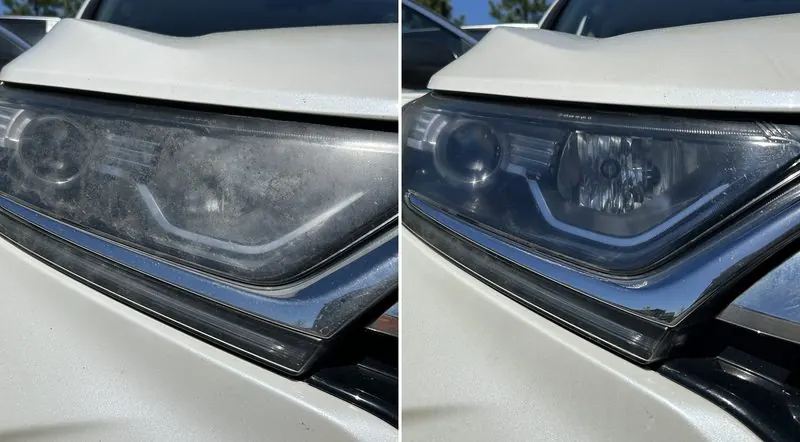
A DIY kit works if you take your time and don't skip the UV coat. Where most people come up short is the coarse sanding (not taking off enough) and the sealing (using a thin wipe-on product that wears off fast). A professional headlight restoration takes all of the oxidation off, polishes the lens clear, and seals it properly. With us it's $120 a pair, done in your driveway, and it usually takes about an hour.
Rather skip the sandpaper? We restore headlights at your home or work for $120 a pair, usually in about an hour. You only pay after you've checked them.
How Long Does Headlight Restoration Last?
It depends almost entirely on how well the lens is protected afterward and how much sun it gets. A lens that's sanded and polished but never sealed can start yellowing again within months. A properly sealed lens on a car that's garaged or parked in the shade lasts much longer. Topping off the protection every few months is what keeps it clear.
How to Keep Headlights From Getting Foggy Again
- Park in a garage or in the shade when you can. The sun is what causes it.
- Top off the UV protection with a ceramic sealant every couple of months.
- Hand wash them with a soft mitt. Skip brush car washes and harsh degreasers on the lenses.
- If you're protecting the whole car, a ceramic coating can go on the headlights too. More on your options in wax vs. ceramic sealant vs. ceramic coating vs. PPF.
Why Foggy Headlights Matter More in Winter
In Charlotte, the earliest sunset of the year is around 5:10 p.m. in early December, per WeatherSpark, so most evening commutes happen in the dark, often in cold rain. That's exactly when a lens putting out a fraction of its light hurts most. The haze also scatters light into the eyes of oncoming drivers. Our winter car care guide covers the rest of the car, from paint to the interior.
We Restore Foggy Headlights All Over the Charlotte Area
Headlight restoration takes about an hour, so it's an easy one to get done while you're at work or at home. We come to Ballantyne, SouthPark, Dilworth and South End, Quail Hollow and Carmel, and the rest of Charlotte, plus Concord, Kannapolis, Huntersville, Cornelius, Mooresville, and Gastonia. In Union County, we're in Monroe, Indian Trail, Matthews, Mint Hill, Wesley Chapel, Weddington, and Waxhaw. Over in York and Lancaster counties, we cover Rock Hill, Fort Mill, Tega Cay, and Indian Land. We also serve Greensboro and Raleigh. Not sure if you're in range? Check our service areas.
A lot of customers add headlights to a premium hand wash, a wash and wax, or a paint polishing, since the car is already getting worked on. See more before-and-afters in our exterior gallery and interior gallery, read our reviews, grab a gift card, or reach out with questions.
Ready to get it done? Tell us what you drive and send a photo or two of the headlights.
We also offer maintenance detailing every 2 or 4 weeks, plus RV detailing, boat detailing, and fleet washing. Wondering what a full detail runs? See how much car detailing costs in Charlotte, or read how often you should get your car detailed.
Just had your interior done? Here's how to keep your car interior clean between details.
Headlights are usually one part of a bigger refresh. If the paint looks as tired as the lenses, paint correction removes swirls and scratches, and paint overspray removal takes off specks from nearby painting. Under the hood, an engine bay cleaning pairs well with clear headlights. Inside, choose a full interior detail or a quicker mini interior detail, and add smoke odor removal if the car smells like smoke. We're also getting ready to offer window tint and paint protection film. For more how-tos, browse our car care blog.